Which words make a chatbot answer better? The question sounds like a search for magic phrases, or for settings hidden somewhere that experts change. There are settings, and I will come to them. But the honest answer is less exciting and more useful: the answer moves when the request gets better, and a better request follows rules anyone can learn.
A colleague and I wrote a course on exactly this, for professionals who are not engineers. The only prerequisite is access to a chatbot such as ChatGPT or Microsoft Copilot. The course runs under three hours, and the agenda says where the weight lies: an hour on prompt structures, three quarters of an hour on the criteria of a good prompt, the rest on the basics and on the ways a prompt goes wrong. What follows is the core of it, and it holds whichever model sits behind the chat window: GPT-4o, Claude 3.5 Sonnet or Gemini 1.5 Pro.
The model has no memory, the prompt does
A large language model is trained on a vast amount of text and learns to predict the probability of the next word, or more precisely the next token, in a sequence. It can summarise, translate, classify sentiment or draft text because each of those tasks comes down to predicting what plausibly comes next. It also has a limit: a maximum number of tokens it can take in and give back per request.
The second fact matters more for everyday use. The model is stateless: it keeps nothing between two requests. When a chatbot seems to remember what you said ten messages ago, it is the application sending the earlier exchange back with your new message. Everything the model knows about your situation is what sits in that window. If the context is not in the prompt, it does not exist.
Two dials: temperature and Top P
At each step, the model holds a list of candidate tokens, each with a probability. Two parameters act on how one is picked.
Temperature reshapes the odds of every candidate. Low, it sharpens them: the most probable token wins almost every time, and the answer becomes focused and repeatable. High, it flattens them: less likely tokens get a real chance, and the answer becomes more varied, sometimes incoherent. OpenAI’s API accepts values from 0 to 2; Anthropic’s from 0 to 1, with 1 as the default. Even at 0, Anthropic’s reference warns, the results are not fully deterministic.
Top P, also called nucleus sampling, does not reshape the odds: it shortens the list. The model ranks the candidates from the most probable and keeps them until their combined probability reaches P. At 1, nothing is removed. At 0.1, OpenAI’s reference says, “only the tokens comprising the top 10% probability mass are considered”: not the top 10% of words, but as few words as it takes to reach 10% of the probability, which may be a single one.
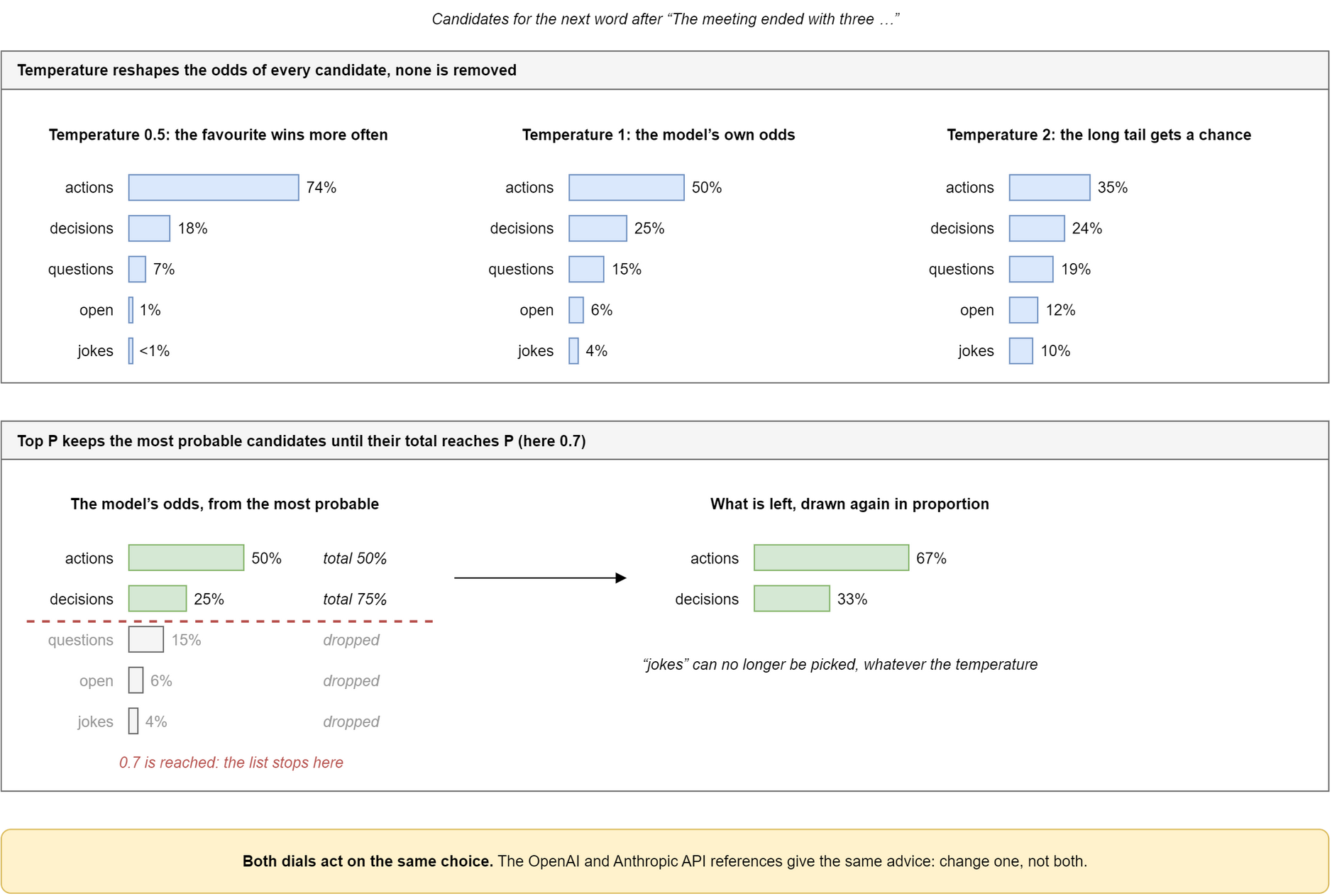
Both references give the same advice. OpenAI: “We generally recommend altering
this or top_p but not both.” Anthropic: “You should either alter temperature
or top_p, but not both”, and it adds that Top P is for advanced use cases,
since you usually only need temperature. The reason is plain once the figure is
in front of you: both dials act on the same choice. Turn the two at once and you
can no longer tell which one changed the answer.
There is a catch for anyone who is not an engineer: chat windows do not show these dials. They live in the APIs and in the developer consoles, such as OpenAI’s Playground, Anthropic’s Console or Google AI Studio. In ChatGPT or Copilot, the provider has set them for you. Typing “use a temperature of 0” into a chat changes nothing in how the tokens are drawn. In a chat window, the prompt is the lever.
Five criteria of a good prompt
The precision of the instruction sets the quality of the answer. The course gives five criteria, each with a poor and a good example.
Clarity and precision. The poor version: “Summarise the following meeting notes.” The good one says what to look for and what to produce:
Your task is to review the meeting notes below and write a concise summary
of the essential information: the key points and the actions assigned to
specific people or departments. Use clear, professional language and organise
the summary with headings, subheadings and bullet points. Make it easy to
read, complete but brief, and state clearly who owns each action.
The notes are: "..."
Objective. Say what you expect, with a command verb: explain, summarise, clarify, help. “How do I add numbers in Excel?” gives a generic tutorial. “Explain step by step how to add up a row of amounts in euros, automatically for every row of a sheet, with each total in a column on the right called Total” gives the formula you need.
Style. Realistic, abstract, academic: say which. Asking for a critical review of a story “from the point of view of a creative-writing student”, focused on narrative technique, characters, themes and stylistic choices, and only on what the story itself contains, gets a review rather than a plot summary.
Tone. Formal, informal, professional, humorous. “Announce to the team that the office closes at 6 pm from next month, in a warm but professional tone, without jokes” leaves the model nothing to guess.
Constraints. Length, output format, quantity. “Generate 12 questions to interview a marketing candidate” is a constraint without a context. The good version first describes the role (a marketing manager for an established e-commerce company) and the experience expected (multichannel campaigns, analytical skills, work across teams), and only then asks for 12 open questions that draw detailed answers.
The course lists further criteria beyond these five: format, scope, keywords, length limits, audience, language, sources and quotations, points of view, counter-arguments, terminology, analogies, statistics, visuals, a call to action, sensitive subjects to handle with care. None of them is technical. Each is what a capable colleague would ask before starting the job. A poor prompt is a vague brief, and the model, unlike the colleague, does not ask questions: it guesses.
Structures: the criteria assembled
There are more than fifty prompt strategies in circulation. The course teaches seven, each built on the criteria above.
The first three are templates that put the criteria in order:
- RTF, Role, Task, Format, for an answer shaped by expertise: “As an IT security expert, analyse the potential threats in a microservices environment and present a list of actions for each threat.”
- CTF, Context, Task, Format, when the situation matters more than the expertise: “I am building a microservices architecture for an e-commerce application. List the advantages of microservices for this application as bullet points, at least four.”
- RASCEF, Role, Action, Steps, Context, Examples, Format, for complex requests where a specific result matters: strategy, teaching material, detailed analysis.
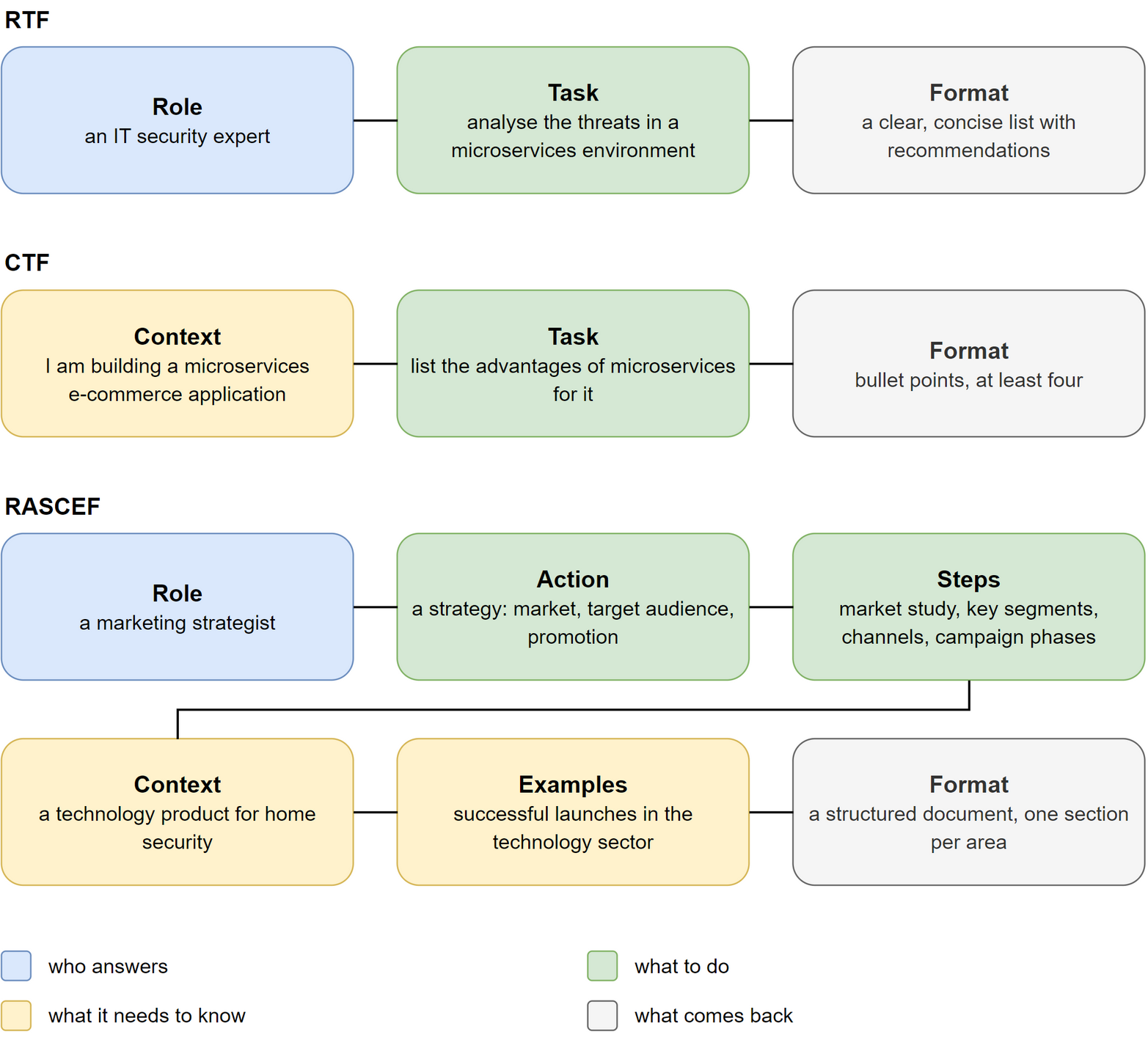
The RASCEF example of the course, written out:
Role: you are a marketing strategist.
Action: build a strategy that covers a market analysis, the target
demographics and the promotional activities.
Steps: start with a market study, identify the key audience segments,
select the marketing channels, plan the phases of the campaign.
Context: the product is a technology innovation for home security.
Examples: draw on successful launches in the technology sector.
Format: a structured document with a section for each key area.
The next three change how the model works rather than what it is told.
Few-shot shows instead of explaining. To classify customer reviews, give three labelled examples, one positive, one negative, one neutral, then the review to classify. The model follows the pattern; the technique excels at classification, sentiment analysis and data extraction.
Chain of thought asks the model to reason step by step before it answers. The course uses an investment question: a low-risk bond fund with an expected 3% a year, or a moderate-risk equity portfolio with an expected 7%, “given my financial goals and my risk tolerance… think step by step”. The steps make the reasoning visible, and they show something else: the prompt never states the goals or the tolerance. Visible reasoning is the quickest way to see what the prompt forgot.
Self-consistency asks for several answers to the same question and keeps the most consistent one, usually the answer that comes back most often. Take two trains, 300 km apart: one leaves at 10 at 60 km/h, the other leaves the opposite station at 11 at 80 km/h. Run the step-by-step prompt three times. The right answer is about 12:43: the first train has covered 60 km by 11, and the remaining 240 km close at 140 km/h. If two runs out of three agree, you have a signal; if all three differ, you have learned not to trust any of them. The method works because the answers vary, which is what a temperature above zero is for.
The seventh is the one the course calls ELIE, “Explain Like I’m Eight”: turn a complex idea into a simple explanation. “Explain gravity as if to an eight-year-old who wonders why things fall when you let go of them.” It suits teaching, content for a general audience and customer-service explanations, anywhere a hard subject has to be made simple.
Four ways a prompt goes wrong
The last part of the course is the shortest, and it is about security.
Prompt injection is malicious instructions slipped in as user input, which make the model follow the injected commands instead of its original ones. For a non-engineer, the practical case is a document, an email or a web page pasted into the chat with an instruction hidden inside.
Prompt leaking is a model revealing its internal instructions under a crafted prompt. Whatever was written into those instructions, sensitive information included, can come out. Anyone setting up a shared assistant for a team should write its instructions as if they were public.
Jailbreaking is leading a model, through specific prompts, to produce unexpected or even dangerous output that its provider meant to prevent.
Misinformation is the one every user meets. Models are not reliable: they can produce false or misleading information at any moment, in the same confident voice as a correct answer. Without verification, that is a vulnerability, not a quality issue. The 2025 edition of the OWASP Top 10 for LLM applications, released this month, puts prompt injection first and lists system prompt leakage and misinformation among the ten.
Asking for sources helps, since that is what the sources and quotations criterion is for, but a cited source still has to be opened. The control that holds is a person who knows the subject reading the answer before it is used.
What moves the answer
For a team that is not technical, the order of the course is the order of the effort. Write the request as you would brief a colleague. Pick a structure when the request is complex. Leave the dials to the people who have them. And read every answer as a draft, because the model will not tell you when it is wrong.